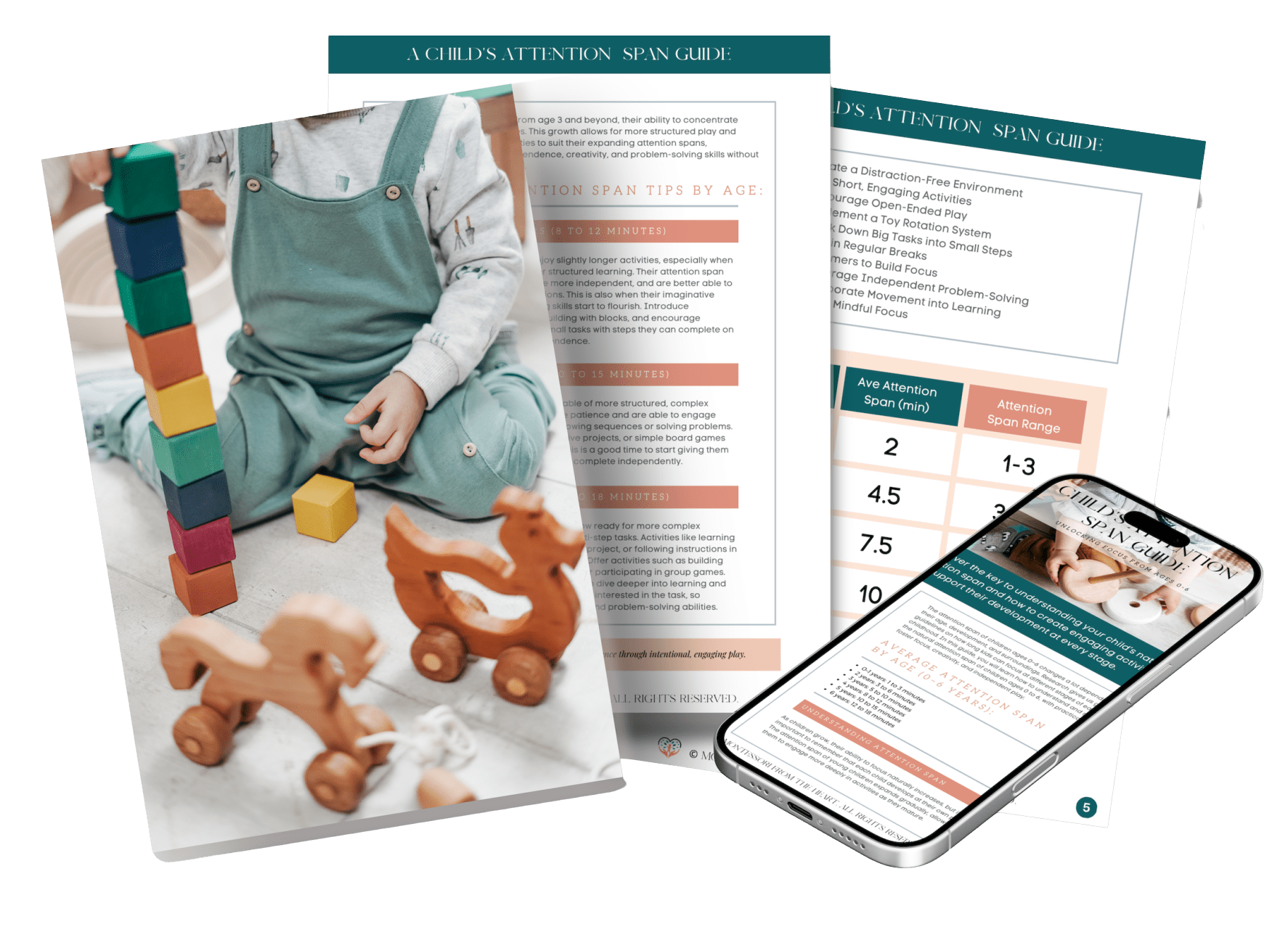


Discover What are Your Child’s 9 Developmental Schemas and receive a free 14-page eBook packed with tips and insights into your child’s development to unlock the mystery behind your child’s unique play patterns.
Have you ever spotted your little one playing in ways that made your eyebrows rise? Well, it’s totally normal! It’s their developmental schema in action also called schematic play! So, learn types of play schemas, what are those 9 Play Schemas and download a Free eBook below.
In early childhood education, particularly within the Montessori and other developmental frameworks, several recognized schemas describe patterns of behavior and play that children often exhibit.
Through schematic play, children engage in repetitive patterns of behavior as they explore and understand the world around them.
Jean Piaget’s Insights
Jean Piaget, a renowned psychologist, emphasized the significance of children’s schemas in their cognitive development. Recognizing and understanding these schemas can provide valuable insights for parents, educators, and caregivers, enabling them to support children’s learning and development effectively.
Join Monthly Kids Activities Plan Subscription for only $0.49 cents a day
Although parenting does not come with the user manual, your homeschooling can! Spend less time searching and more time doing because you’ve got a Plan – The Monthly Kids Activities Plan! So, grab my test-proven strategy that will put you on a fast track toward your homeschooling success for only $0.49 cents a day!

What are the 9 Play Schemas?
Play schemas are patterns of behavior that children frequently exhibit during play. The nine primary schemas are trajectory, rotation, enclosing, enveloping, transporting, connecting and disconnecting, positioning, orientation, and transforming.
Here are nine common schemas in a nutshell and a fun way to think about them:
Trajectory play schema ✈️: Throwing things through the air—like when your kid’s aim is your head! Also 🛤️: Running back and forth or tracing lines. Future marathon runner, anyone?
Enclosure schema ⛺️: Creating boundaries with objects, like building fences with blocks or hiding inside boxes. It’s a fun way for kids to learn about inside and outside! Is your child a future spy, perhaps?
Enveloping schema 📦: Ever caught your kiddo wrapping themselves up like a cozy burrito in blankets or scarves? This schema is all about tucking things away, whether it’s toys snug in blankets or hiding in boxes. It’s like a little exploration into containment, as they discover the fun of objects being enveloped by others.
Positioning schema 🏗️: Carefully lining up toys—so precise, you’d think they’re training for a future as a professional organizer.
Rotation schema 🔄: Spinning and turning everything—even themselves. They could be a tornado in training!
Connecting schema 🔗: Linking train cars or building with blocks. Mini engineer in the making!
Transporting schema 🚛: Moving toys from one place to another. Your house might look like a toy traffic jam.
Transforming schema 🧪: Mixing things together like a scientist—just pray they don’t find the glitter!
Orientation schema 🔍: Looking at things from different angles. Ever seen them upside down on the couch? Yep, that’s orientation.
Understanding these schemas can help you support your child’s unique way of learning and playing.
When do Play Schemas Take place?
Play schemas emerge at different ages based on the skills needed for each one. For instance, as soon as babies can sit up, they start throwing food from their highchair tray to explore the concept of ‘trajectory’ and cause and effect.
‘I throw this, what will happen? Will it make a noise when it hits the ground? How far will it go?’
You don’t need to do it all alone! Let Me Help You on your Homeschooling Journey!
While there is no magic bullet, there is a process! So, let me help you 10X your Homeschooling and Not Your To-Do list!
Choose Montessori and/or Thematical Courses, join our MKAP family subscription, or apply for a Customized Curriculum Plan!

What are 9 Play Schemas | Free eBook
Play Schemas During Early Years in Details
Play schemas are fundamental patterns of behavior that children often demonstrate during playtime. These behavioral patterns are not only natural but also essential for their cognitive development as they actively explore and comprehend the world around them. In the following section, I’ll delve into the intricacies of the nine primary play schemas, shedding light on how each schema contributes to children’s learning and growth.
(1) Trajectory
Trajectory play schema involves the movement of objects or the child themselves through the air. Examples include throwing, jumping, or dropping items. Kids are also fascinated by paths and movement through space, such as running back and forth or tracing lines. This schema also includes an interest in straight or curved paths and movement through space, like running back and forth, tracing lines, or following paths.
So, if you noticed your child showing an interest in throwing things, and oftentimes, they like to throw things that break? Say hello to a trajectory schema where they throw things to learn about cause and effect.
And until they understand how this works, some of these objects might break. However, it is not the breaking that interests little people but the movement.

(2) Enclosing
In this schema, children are inclined to create boundaries or enclosures using various objects. They may build fences with blocks, create boundaries with sticks or ropes, or even use their bodies to enclose spaces. This behavior demonstrates their exploration of spatial relationships and their understanding of containment. Enclosure schema activities often involve creating imaginary boundaries for play areas, building forts or dens, or arranging objects to create enclosed spaces. Through these activities, children develop a sense of spatial awareness and learn about the concepts of inside and outside, containment, and protection.
(3) Enveloping
Enveloping schema is a fascinating aspect of children’s play where they explore containment and the concept of objects being enveloped by others. Ever caught your kiddo wrapping themselves up like a cozy burrito in blankets or scarves? This schema is all about tucking things away, such as wrapping toys in blankets, hiding inside boxes or tents, or even covering themselves with scarves. It’s like a little exploration into containment, as they discover the fun of objects being enveloped by others. This schema involves putting objects inside other objects, such as wrapping toys in blankets or hiding inside boxes or tents. Through these activities, children explore containment and the idea of objects being enveloped by others.
(4) Positioning
Children focus on carefully positioning objects or themselves in specific places. They might line up toys or place items in specific spots repeatedly, showing a keen interest in order and arrangement.
Children often exhibit the positioning schema through activities like lining up wooden blocks, magnetic tiles, cars, or teddy bears, meticulously or arranging items in specific spots. This behavior reflects their focus on carefully placing objects or themselves in particular positions, fostering their spatial awareness and organizational skills.
(5) Rotation
The rotation schema is evident when children show fascination with things that turn or spin. Activities like playing with tops, wheels, or watching objects rotate help children explore concepts related to circular motion, centrifugal force, and rotation. Children might also enjoy spinning around themselves, or watching things rotate, like a ceiling fan or a merry-go-round.
(6) Connecting
Connecting schema involves the desire to connect and disconnect items, such as linking train cars, joining construction pieces, or tying things together with string. Children explore relationships, the concept of joining, and how different parts can come together to form a whole. They may also enjoy activities like building with blocks, assembling puzzles, or creating elaborate structures with building toys.
(7) Transporting
Children engage in the transporting schema when they focus on moving objects from one place to another. This could involve activities like filling and carrying containers or pushing carts, wagons, or transfer items between locations, often delighting in the act of moving things around. Transporting schema provides opportunities for them to develop their gross motor skills and spatial reasoning.
(8) Transforming
This is about changing the state of objects, like mixing substances together, cooking, or engaging in messy play with mud or paint. Children are intrigued by the process of change and transformation.
Transforming schema involves altering the state or appearance of objects. Children may engage in activities like mixing substances together, cooking pretend meals, or experimenting with messy play using materials like mud or paint. Through these experiences, they develop an understanding of cause and effect, observe changes over time, and explore the concept of change and transformation. Transforming schema also includes engaging in science experiments, where children observe how different substances interact and change when combined. Children can conduct experiments like Mixing Colors, Baking Soda and Vinegar Volcano, Growing Crystals, Making Slime, and Exploring Density to learn about science concepts and have fun exploring the world around them.
These experiments foster curiosity, critical thinking, and problem-solving skills as children explore the principles of chemistry and physics through hands-on exploration.
(9) Orientation
Exploring different perspectives and viewpoints is characteristic of the orientation schema. Children explore different perspectives by looking at things from various angles. They might hang upside down, look through their legs, or climb to see things from above, enjoying the novel views and perspectives.
Children may climb to see things from above or look at objects from various angles, enhancing their understanding of spatial relationships and how their position in space influences their perception.
What are the 9 Play Schemas Free eBook ~ get it here.

These schemas are essential for understanding how children learn and interact with their environment. They provide insight into a child’s interests and can guide the design of activities that support their development.
Encouraging Schema-based Play: Creating a Stimulating Play Environment
Creating a Conducive Play Area:
Providing a conducive play area is essential for encouraging children to explore and engage in various schemas. A well-equipped and organized play space offers children the resources and freedom they need to learn and grow through play. By creating an environment that supports open-ended play and provides opportunities for sensory exploration, children can freely engage in schema-based activities and develop essential skills.
Role Play:
Role play offers children a fantastic way to engage in imaginative play, allowing them to take on different roles and act out scenarios. Through role-playing, children develop creativity, social skills, and empathy as they explore different perspectives and interact with others. Encouraging role play in a conducive play area enhances children’s cognitive and emotional development, fostering their ability to communicate, problem-solve, and understand the world around them.
Exploring children’s interests and understanding their world through schema play is a dynamic process that nurtures their natural curiosity and cognitive development. By providing opportunities for children to engage in activities that align with their interests and schema interests, caregivers can support their exploration of different things and foster a deeper sense of the world around them. Children’s schema play reflects their best things, where they immerse themselves in particular behaviors that reveal their schema interests and facilitate the development of key skills. Through schema play, children embark on a journey of discovery and transformation, gaining insights into themselves and the world while honing essential cognitive and emotional abilities.
Multiple Schemas At A Time
Yes, a child can exhibit behaviors associated with multiple schemas simultaneously. Children’s play is often complex and multifaceted, and they may engage in activities that involve aspects of different schemas at the same time. For example, a child playing with toy cars (transporting schema) on a magnetic tile surface (positioning schema) while also building structures with blocks (construction schema) may be integrating elements of several schemas into their play experience. This ability to blend and combine schemas reflects the dynamic nature of children’s exploration and learning processes.
Summary
Young children engage in schema play as they explore the world around them through various forms of play. Whether it’s pushing toy cars along imaginary roads, stacking building blocks to create structures, or laying out train tracks to form intricate railways, children’s play is often driven by their schemas. Sensory play, such as digging their hands into sand or squishing playdough, not only entertains but also helps develop their fine motor skills and satisfies their curiosity about different textures. Observing a child’s interests can provide insight into their particular schema, whether it’s their fascination with small objects or their love for paper planes. By encouraging schema play, parents and caregivers support children’s brain development and foster a deeper understanding of the world around them. In my latest blog post, I delve into the importance of recognizing and nurturing children’s schemas in their play areas.
For More Early Years,
90% of a child’s brain develops by age 5
See Here – 90% of a child’s Brain Develops Before kindergarten

For Baby Cognitive Development
Read here – Children are born creative geniuses

For More Montessori Philosophy …
See here Avoid Judgment and Empty Praise Montessori Principle.

RECENT BLOG POSTS

Mackenzie-Childs Easter Decor Ideas | Charming Spring Home Inspiration
Mackenzie-Childs Easter decor ideas bring cheerful spring charm to your home and inspire a warm, welcoming Easter space for family gatherings.

Spring Montessori Activities for Preschoolers | Simple Hands-On Learning at Home
Spring Montessori Activities for Preschoolers bring calm, hands-on learning into your home, so your child explores nature, builds skills, and grows in confidence.

Easter Activities Round Up for Preschoolers at Home | Simple Hands-On Learning
Easter Activities Round Up for Preschoolers at Home bring simple hands-on learning that builds fine motor skills, early math, and calm focused play for little learners.


