Learn how Montessori lacing shapes support fine-motor skills, hand-eye coordination, concentration, shapes, colors, and early sewing skills for young children.
Lacing is one of those simple activities that can keep a young child surprisingly engaged. A piece of string, a few holes, and a wooden shape may not look like much to an adult, but for a toddler, threading the lace through each hole requires concentration, coordination, and plenty of practice.
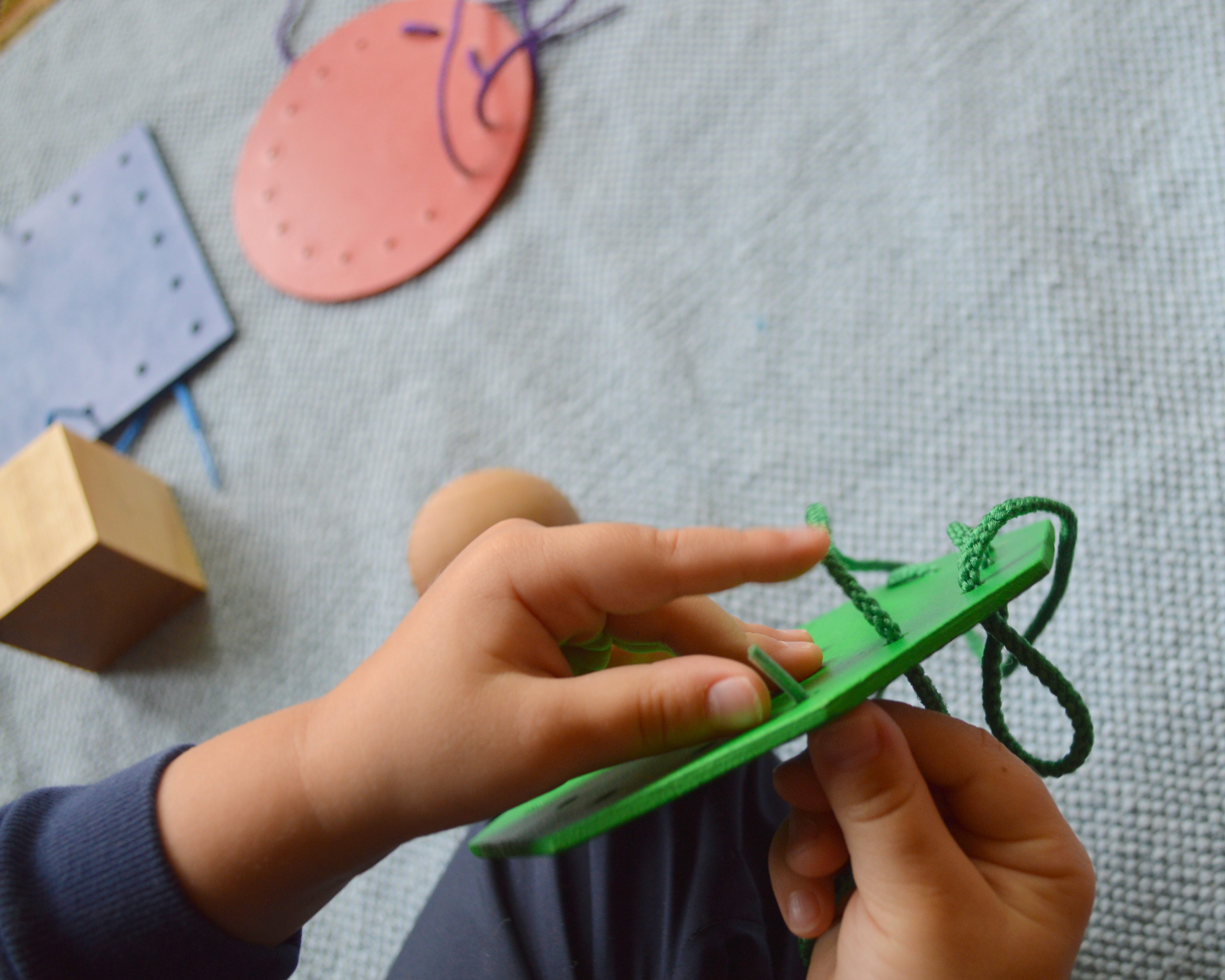
I first introduced lacing shapes to Adrian at around 18 months. At that age, he was interested in the material, but he was not quite ready to actually thread the lace through the holes. I simply let him explore it without expecting him to complete the activity. Later, when his hand control and coordination had developed, he quickly caught on and began threading the lace through the pre-punched holes over and over again.
That progression is one of my favorite things about Montessori-inspired activities: the same material can meet a child at different stages of development. There is no need to rush the child to “complete” the activity. Sometimes simply handling the material, turning it over, pulling the lace, or watching you demonstrate is the preparation for what comes next.
What Are Montessori Lacing Shapes?
Montessori lacing shapes are wooden or sturdy flat shapes with evenly spaced holes around the edges. The child uses a lace to thread in and out of the holes, gradually outlining the shape.
The set we used included six geometric shapes—a circle, triangle, octagon, hexagon, pentagon, and square—with color-matched laces. The shapes provided an opportunity to work on several concepts at once:
- Fine-motor coordination
- Hand-eye coordination
- Bilateral coordination
- Concentration and persistence
- Shape recognition
- Color matching
- Following a sequence
- Preparation for future sewing activities
Lacing is also closely connected to Montessori Practical Life. Montessori Services describes stringing and lacing as preliminary activities that help prepare children for sewing and other handiwork. The repeated movements give children an opportunity to refine coordination while developing concentration.
When Can a Child Start Lacing?
There is no single “right” age for lacing.
A child may be interested in exploring a lacing activity around 18 months to 2 years, but being interested in the material is very different from being ready to thread independently. Some toddlers will begin by pulling the lace, carrying the shapes, or putting the lace through a hole with considerable help. Others may not show much interest until closer to age 2½ or 3.
By the preschool years, many children are ready for more purposeful lacing and sewing activities. The American Montessori Society includes practical, hands-on activities that develop refinement of movement as part of the Early Childhood Montessori curriculum for children approximately 2½ to 6 years old.
The important thing is to follow the child rather than the age on the box.
If your toddler becomes frustrated, put the activity away and try again another day. If your child wants to repeat it twenty times, let them.

What Children Learn Through Lacing:
Fine-Motor Control: Lacing requires small, controlled movements of the fingers and hands. The child must grasp the end of the lace, orient it toward the hole, push it through, find it on the other side, and pull it back out. That sounds simple when described step by step, but it requires considerable coordination for a young child. The American Academy of Pediatrics notes that as children develop, they become increasingly capable of manipulating small objects and coordinating their fingers, hands, and wrists. Activities involving blocks, drawing, construction, and other hands-on materials provide opportunities to practice these emerging skills. Lacing gives children another meaningful way to practice.
Hand-Eye Coordination: The child’s eyes guide the hands toward a relatively small target. They have to look at the hole, position the lace, and adjust their movements based on what they see. With repetition, the movements become more controlled and efficient. This is one reason I like lacing as a quiet tabletop activity. The child is not simply moving their hands; they are constantly coordinating what they see with what their hands are doing.
Bilateral Coordination: Lacing naturally encourages the use of both hands. One hand may stabilize the wooden shape while the other pushes and pulls the lace. Then the roles may switch. The child learns that the two hands can work together to accomplish one task. Montessori materials and activities frequently give children opportunities to coordinate both hands in purposeful ways. The American Montessori Society’s materials on Practical Life similarly connect hands-on activities with coordination, hand control, and growing independence.
Concentration and Persistence: Lacing is repetitive by nature. The child performs essentially the same movement again and again. Push the lace through. Pull it out. Move to the next hole. Repeat. That repetition can be valuable. Montessori-inspired activities often allow children to repeat a movement until they feel satisfied with their own work rather than stopping after one attempt. You may notice that a child who initially struggles becomes increasingly focused as they begin to understand how the material works.
Shape Recognition: Because the child is physically following the outline of a shape, lacing can also become a simple geometry activity. You can name the shapes as you work:
“This is a triangle.”
“This one has six sides. It is a hexagon.”
There is no need to turn the activity into a formal lesson. The child can absorb the vocabulary naturally while their hands explore the shapes. For younger toddlers, simply using words such as circle, triangle, square, big, small, side, and corner is enough.
Color Matching: If your lacing set includes color-matched laces, you can invite your child to match the lace to the corresponding shape. Again, keep it simple. “This is red. Can you find the red lace?” The child is simultaneously practicing visual discrimination, matching, and fine-motor control.
Lacing Shapes and Preparation for Sewing:
One of the reasons lacing is particularly appealing in a Montessori environment is that it can serve as an indirect preparation for sewing.
Of course, a toddler using a lacing shape is not actually learning to sew yet. But the child is practicing some of the movements involved in later sewing: controlling a thread-like material, pushing it through an opening, pulling it through, and repeating a consistent sequence.
Montessori Services specifically describes lacing as a preliminary activity for sewing and notes that children can progress from lacing to simple sewing exercises as their skills develop.
For a young child, this is enough. Preparation does not have to look like the final skill.
Adrian’s Lacing Activity:
When I first introduced this activity to Adrian at around 18 months, he was interested in the shapes but was not ready for the threading itself.
I did not try to make him complete it.
Instead, I let him explore the material. Later, once he was more comfortable with the idea of threading, he quickly learned the lacing motion and repeated it through the pre-punched holes.
I love watching that transition.
At first, the material was simply something interesting to touch and investigate. Later, he had the coordination and understanding to use it with a purpose.
Interestingly, in one of the photos, Adrian was using his left hand even though he predominantly worked with his right. I mention this because toddlers do not eed to be pushed toward a particular hand. Hand preference can take time to become consistent, and the American Academy of Pediatrics notes that many young children do not establish a clear hand preference for several years.
Let your child experiment with both hands.
Montessori Benefits Of Lacing:
From a Montessori perspective, lacing can bring together several areas of development in one simple activity:
Practical Life: The child practices purposeful hand movements and works toward greater independence.
Sensorial: The child explores color, shape, texture, size, and the physical properties of the materials.
Geometry: The child handles and names geometric shapes and can begin distinguishing flat shapes from solid forms.
Fine-Motor Development: The child practices controlled movements of the fingers, hands, and wrists.
Concentration: The repetitive sequence encourages sustained attention.
Preparation for Future Skills: Lacing can prepare the hands for later sewing and other forms of handwork.
The American Montessori Society describes Montessori Practical Life as a core area of early childhood education and includes activities designed to refine movement and support growing independence.
Summary:
I love activities like lacing shapes because they are simple, purposeful, and easy to adapt as a child grows.
At 18 months, a child may simply explore the shape and lace. A little later, they may begin pushing the lace through one hole. Eventually, they may lace an entire shape independently and be ready to move on to sewing.
The material has not changed. The child has.
That is what makes these activities so rewarding to revisit. Instead of expecting a toddler to master a skill before they are ready, we can offer an inviting material, demonstrate how it works, and give them time to grow into it.
For us, lacing became more than a fine-motor activity. We combined it with color matching, shape recognition, geometry, and three-dimensional geometric solids—turning one simple material into a rich, hands-on learning experience.
Sensorial, Practical Life, and Geometry—all in one.
And perhaps most importantly, Adrian was learning through his hands, at his own pace.
For More Shape Learning Activities,
Want More Hands-On Ideas Like This?
Sign up for the Monthly Kids Activities Plan (MKAP) and receive themed activities, printables, and video tutorials each month—so you can spend less time searching and more time playing!
Click here to learn more about MKAP.

Disclosure: As an affiliate, I may earn a commission or credit should you choose to purchase something, but there is no additional cost to you. I only share products and programs that I use and love!
RECENT BLOG POSTS
Montessori Language Materials | Fun Phonics Play at Home
Montessori Language Materials | Fun Phonics Play at Home builds easy reading skills without screens, so your preschooler stays happily engaged.
Montessori Math Resources at Home | Simple Screen Free Learning
These Montessori math resources at home bring screen-free joy to early learning, build deep number confidence, and use simple materials you already own.
Montessori Sensorial Materials | Simple Learning Through Play for Preschoolers
Discover Montessori Sensorial Materials for simple learning through play for preschoolers and help your child build focus, fine motor skills, and early thinking through hands-on learning.