
A Montessori continent or a country box (like China) is a hands-on opportunity for children to explore diversity, distant lands, cultures, people and traditions as a part of Montessori Cultural geography study.
Children love “treasure boxes”, especially ones filled with things that are new, uncommon, ones that tell a story: about a far-far-away land and people: how they look, what people wear, eat; what their traditions and customs are, what animals live there, etc. So, in the essence, a Continental box is a miniature story of the entire continent. You may further subdivide a Montessori CONTINENT BOX into a COUNTRY Box, for example, ASIA to CHINA, with objects pertaining to a particular country. You may fill it with any artifacts that represent that continent or country like pottery, utensils, fabrics, tapestry, bookmarks, money-currency, stamps, pictures of children, people at work, unique foods, flags, maps, books- child-level etc. Montessori Cultural Continent box (or a Country box, like China in this post) is a wonderful hands-on fun way to expose your child to the diversity of our world, indirectly teaching geography and culture. There is really no better way to learn!
CONTINENT BOXES ROOT IN PEACE EDUCATION
One is my favorite things about the Montessori curriculum is the emphasis on other cultures and other places in the world. In the geography area, children explore different countries and cultures and what it’s like to live there. Children learn how there are MANY different people all over the world and diversity is espoused very early on! Most importantly, Montessori education is based, among other things, on PEACE education, which focuses on the way cultural awareness can foster a more peaceful non-violent world. Children, as part of the Montessori curriculum, gain awareness of the world around them by exploring different countries, cultures, customs, food, ethnic attire, music, climate, language, animals, etc. By raising our consciousness about human diversity, we learn to understand and accept our similarities and differences; we do not tolerate discrimination, and we become more compassionate towards ourselves and others. My children respect the differences, and often admire other cultures. So, I was inspired to start “making” (better say collecting) CONTINENT BOXES, the activity, which became the favorite of my children!
So here is a great way to explore different parts of the world with your children.
What what you will need to create continent boxes
- find 7 either wooden, cardboard or plastic boxes (shoe/storage containers can work)
- paint (or cover with paper) each one with the shape and name of the content so a child can identify easily
- Collect things! Think of it as a treasure hunt! Check your local convinience store for things that might look from other countries. For example, visit a Chinese grocery or a Russian food store. Or next time you are at a Chinese restaurant, take a menu to go along with spare chop sticks. Look for picture ~ expired calendars can be a great source! Look at magazines! We LOVE National Geographics! If someone lives afar, ask them to send a postcard with a little description, or ask to mail you some souvenirs.

HOW TO PRESENT Montessori Continent Box | ASIA
- Unroll a rug and invite a child to sit to your left. The child should sit by your left hand if you are right-handed. In other words, you should sit on the Child’s dominant hand.
- Show a child a CONTINENT BOX and say: “We will explore the continent of ASIA today.” Open the box and take items one-by-one placing them on a rug and discussing each. For example:
- Take out a bamboo placemat ~ “In Asia, some floors have bamboo or weaker or straw.”
- Take out chopsticks: “In Asia, people don’t use silverware ~ they use chopsticks. Would you like to try to hold them?” SEE HERE a video tutorial “How to Use Chopsticks.”
- Take out some unique dishes or pottery.
- If you can find some native tapestry or beautiful fabric
- If someone travels, ask them to bring your a bookmark
- Take out money (you can also print them off the internet) “Money look different – some have a hole right in the middle; some money have a scalloped edge.”
- Show pictures and describe either place or people : Ask: what do you think happens in this picture?
- Show unique picture of animals or animals figurines
- Show pictures or menus of unique food like sushi
- Print and laminate pictures of maps of the countries. Get a map and find where the postcard was sent from.
- Print a simple fact card that can be your conversation starter
TIP: Laminate all pictures or images on a yellow background for easier identification. In a Montessori Cultural curiculum ALL continents are color-coded:
- NORTH AMERICA – ORANGE
- SOUTH AMERICA – PINK
- EUROPE – RED
- AFRICA – GREEN
- ASIA – YELLOW
- AUSTRALIA – BROWN
- ANTARCTICA – WHITE
INTRODUCE IN PIECES: For example, one day talk about people, then food, then flags. Children do not have a long attention spam and this study can be extensive so present it in small parts.
Montessori Continent Box CHINA
COUNTRY BOX
An extension of a Cultural box would be to create a COUNTRY BOX. For example, my parents lived in Asia for a long time, so we started with the ASIA continent box. But soon, we realized that we have too many beautifully collected relics representing so many parts of Asia, and the box was getting SO BIG, that we decided to subdivide our Asia Box into few boxes: China (below), South Korea, Japan, etc.
CHINA 🇨🇳 CONTINENT BOX


This picture was taken by my parents during their trip to China in 2015.
 Learning the geographic location of China.
INSIDE CHINA Montessori Continent Box
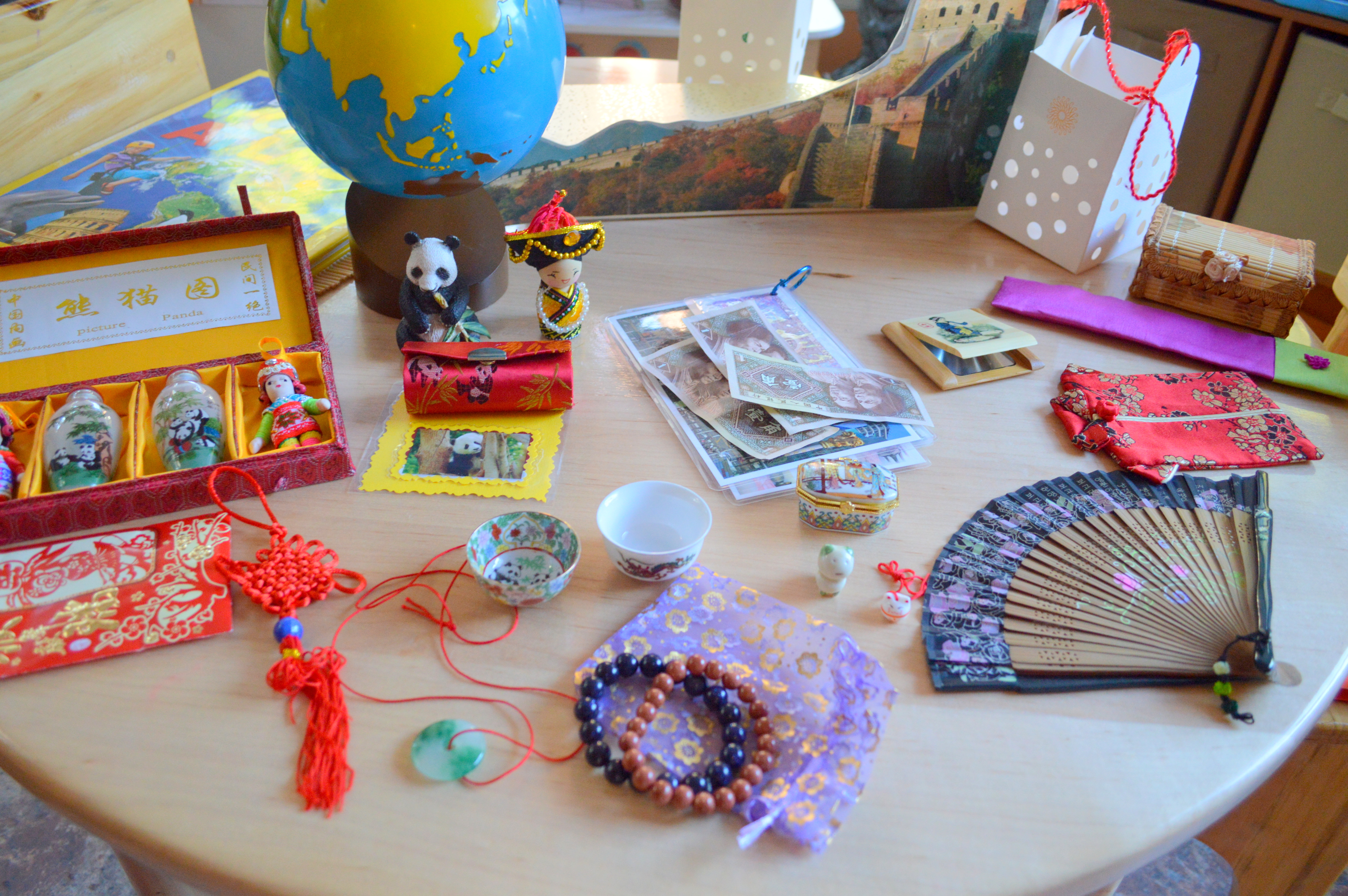
You can either explore CONTINENT BOX in a table or on a floor mat.
 Kitty bracelet against the evil spirit.


 Jade pendant with Dragon silhouette on it.
A snuff bottle, which Adrian is holding, is painted from inside, using a diminutive 90 degree angled brush. This labor (called “CuiQiXuan”) is very skillful and represents a unique traditional Chinese form of art. “CuiQiXuan” is a type of backhand painting on the inner wall of the frosted container with GouBi. The inside-art-painting originated from similar snuff bottles and has two hundred years of history since the Qing Dynasty. Initially, snuff bottles were given to foreign country officials representing a cultural gift from the country of China.
 Adrian cannot believe that someone had painted this bottle from the inside with a tiny brush.
 Chinese🇨🇳 Money – Yuan
While the renminbi is the official Chinese currency, which means “people’s currency”, the Yuan 元/圆; is the basic unit of the renminbi, and is also used to refer to the Chinese currency generally, especially in the international contexts.
 Julia was very interested to know how a Chinese girl looks.
 Postcards from my Parents from China.
Montessori Continent Box CHINA
As part of the cultural education, we would then talk about the things that represent China. So, when we think of China – we think of:
- The Great Wall of China and the Great Chinese Civilization;
- Imperial Palaces and its aesthetically balanced architecture;
- Jade, or Nephrite – the “imperial gem” of China;
- Dragons (the kind and gentile ones 🙂
- Panda – a symbol of good luck, which recently replaced the dragon as an emblem of China;
- Green Tea and China’s omnipresent Teahouses;
- Pearls;
- Color Red;
- And, of course, the deep embedded humbleness and reverence this culture portrays.
THE GREAT WALL OF CHINA

The Great Wall of China was built over centuries by China’s emperors to protect their territory. Today, it stretches for thousands of miles along China’s historic northern border. The Great Wall of China is one of the most notorious structures in the entire world, stretching over 4,000 kilometers (2,500 miles).
IMPERIAL PALACES

Summer Palace, called “The Museum of Royal Gardens” is a masterpiece of Chinese landscape-garden design.

My parents had visited the Summer Palace in Beijing (China’s Capital), so they sent us the palace guide.

The Summer Palace is the largest and most well-preserved royal park in China. The natural landscape of hills and gardens, a vast number of lakes and open water is combined with artificial features such as pavilions, halls, palaces, temples and bridges to form a harmonious ensemble of outstanding aesthetic value.

JADE – the “IMPERIAL GEM” of China

Jade ( or Nephrite) is considered the “imperial gem” of China. Chinese people believe that it protects against the evil spirit and also possess some healing properties. Since Jade was considered more valuable than gold or silver, some Chinese Kingdoms had been making yearly tribute payments to the Chinese Imperial Court in the form of the most precious white jade, which would be transformed by skilled artisans into objects of art or jewelry. Also, jade was used to create many utilitarian and ceremonial objects, ranging from indoor decorative items to jade burial suits.

While nephrite jade possesses mainly grays and greens (and occasionally yellows, browns or whites); jadeite jade, which is rarer, can also contain blacks, reds, pinks, and violets.

One of the main Chinese treasures is the Jadeite Cabbage, intricately cut from a solid piece of jade. It was transported to Taiwan for preservation during the Chinese revolution. It is now part of the Chinese Emperor’s collection displayed at the National Palace Museum in Taipei, Taiwan.

Most Chinese women wear bracelets similar to the above, which are cut from a solid piece of Jade.
Nephrite can be found in a translucent white to very light yellow form which is known in China as mutton fat jade. It can also be found in an opaque white to very light brown or gray which is known as chicken bone jade, as well as in a variety of green colors. However, Jade, which can vary in color, predominantly comes in green.
DRAGONS
The dragon is still a very popular and strong symbol of China. Chinese people actually believe that dragons once roamed the Earth, but that dragons had been kind in nature (not the fire-breathing monsters as perpetuated by western religious writings).

PANDA
Panda, a quintessential Chinese symbol of friendship and peace, is often compared to Yin and Yang because of its black and white stark contrast to one another on panda’s pelt. Panda’s calm demeanor is a demonstration of how, when balanced, Yin and Yang are harmonious and peaceful.

Chinese people adore panda, and many revere it as a symbol of good luck. Recently, the panda has replaced the dragon as an emblem of China. The image appears on many coins, souvenirs, dinnerware, and more.
The giant panda 大熊貓; is a bear native only to few mountain ranges in central China. It is easily recognized by the large, distinctive black patches around its eyes, over the ears, and across its round body. Though panda is a carnivore, its diet is 99% bamboo, and only occasionally it might consist of other grasses, wild tubers, or even meat in the form of birds, rodents, or carrion.
 We read a book about Panda and its decreasing population.
CHINESE GREEN TEA
Green Tea and the Teahouses
 Green tea is the most popular drink in China. There are many tea houses, where you can have a tea ceremony and taste a variety of very good Chinese green teas. Usually, after the ceremony, people would buy the tea they liked, but a purchase is not required. Along with green tea, one can also buy tea cups, kettles and other small souvenirs.
PEARLS

China is well known for its production of freshwater cultured pearls. Unlike saltwater pearls, which are usually cultivated in protected lagoons or volcanic atolls, freshwater pearls are cultivated in lakes, rivers, ponds and other bodies of fresh water and are famous for its lustrous glow and unusually sparkling color.

COLOR RED

To the left is “obereg” – an object, that according to superstition, has a magical ability to protect its owner from various misfortunes. (Most Chinese families hang an obereg, but larger, in their homes for good luck.) To the right is a napkin holder in a form of a traditional women red silk dress.

Notably, the red color is Chinese women’s favorite color of clothing. Red is even worn by brides (on the picture above) since it symbolizes love, wellbeing, and health. “White” on the other hand, Chinese people associate with death and wear it when someone had died.

Montessori Continent Box | CHINA
Children enjoy learning about the far-far-away land, about its people, traditions, customs. And they can connect even more with foreign intriguing countries by holding a little cup made by a Chinese pottery artisan, by reading postcards affectionately written to them by my parent, and by trying on a bracelet or a string of pearls.
I want to sincerely thank my parents for providing all the treasured objects, the information, and all these beautiful pictures of China, which they took first-hand.
MORE ON CONTINENT BOXES

- Read here a post about a Chinese 🇨🇳 New Year🐉 of a🐓 Rooster, and how we celebrate it.
- Read here Martisor Day – How we celebrate the Beginning of Spring 🌸 with Eastern-European Continent 📦 Box.
- Read here International Women’s Day 💐 (IWD) – How We Celebrate with Western-European Continent 📦 Box.
Have you collected artifacts from foreign countries? Leave a comment if you liked our Montessori Continent Box which we subdivided into CHINA.
RECENT BLOG POSTS

Mackenzie-Childs Easter Decor Ideas | Charming Spring Home Inspiration
Mackenzie-Childs Easter decor ideas bring cheerful spring charm to your home and inspire a warm, welcoming Easter space for family gatherings.

Spring Montessori Activities for Preschoolers | Simple Hands-On Learning at Home
Spring Montessori Activities for Preschoolers bring calm, hands-on learning into your home, so your child explores nature, builds skills, and grows in confidence.


Easter Activities Round Up for Preschoolers at Home | Simple Hands-On Learning
Easter Activities Round Up for Preschoolers at Home bring simple hands-on learning that builds fine motor skills, early math, and calm focused play for little learners.