

Explore Australia Animals Sensory Bins Activities for Preschoolers with fun setups like an Australia Arid Desert Environment Komodo Dragon play tray, Snack Tray Hack, and a recycled toilet paper roll Australian Animals Hotel!
You can explore the wonders of Australia on Australia Day (January 26) or any time of the year! Known for its arid climate, desert landscapes, and vibrant coral reefs, Australia offers endless opportunities for learning through play. Sensory play is especially valuable for children, as it supports language development, cognitive growth, fine motor skills, problem-solving, and social interaction. When children engage in hands-on activities, they activate multiple neurons through tactile, visual, and language stimuli, boosting brain development. With this Australia Animals Sensory Bins Activities for Preschoolers, your child will learn by doing—creating, building, and exploring in a fun and engaging way!
“What the hand does, the mind remembers.”
Maria Montessori
The Power of Sensory Play Trays: Research-Backed Benefits
Sensory play trays are more than just fun—they’re a gateway to incredible developmental benefits backed by science. Not only are these trays simple to set up with everyday materials, but they also provide children with engaging, hands-on experiences that promote crucial skills like fine motor development and hand-eye coordination.
Did you know that combining the sense of touch with other senses—such as vision, hearing, smell, and even taste—significantly enhances cognitive growth? Research shows that the nervous system is inherently multisensory from its earliest stages. For example, when a toddler explores food, they use touch to feel textures, smell, and taste to identify flavors and their vestibular sense to balance while seated. These multisensory experiences are essential for building a strong foundation of cognitive and motor skills. Pediatricians now advocate for such simultaneous stimulation to enhance brain development.
Power Of Multisensorila Stimulation
Hands-on sensory play stimulates neural pathways, creating new synapses and strengthening brain connectivity. This process improves memory retention, problem-solving skills, and overall brain agility. Beyond motor skills, children develop language, social interaction, and reasoning abilities as they play, learn, and explore.
In fact, sensory play taps into the natural ways children learn best—by doing! Whether they’re scooping, pouring, sorting, or manipulating materials in a sensory tray, they are engaging multiple senses, fostering creativity, and developing a deeper understanding of their world.
This is why sensory play is so transformative—it doesn’t just entertain, it lays the groundwork for lifelong learning and cognitive growth. So, let’s celebrate the magic of sensory play trays and the incredible benefits they bring to a child’s developing mind and body!
Research Reference:
- K. J. Casey et al., Multisensory Integration and Its Role in Child Development, Journal of Pediatrics, 2020.
- Montessori, M., The Absorbent Mind, 1949.
Australia Arid Desert Komodo Dragon Sensory Bin

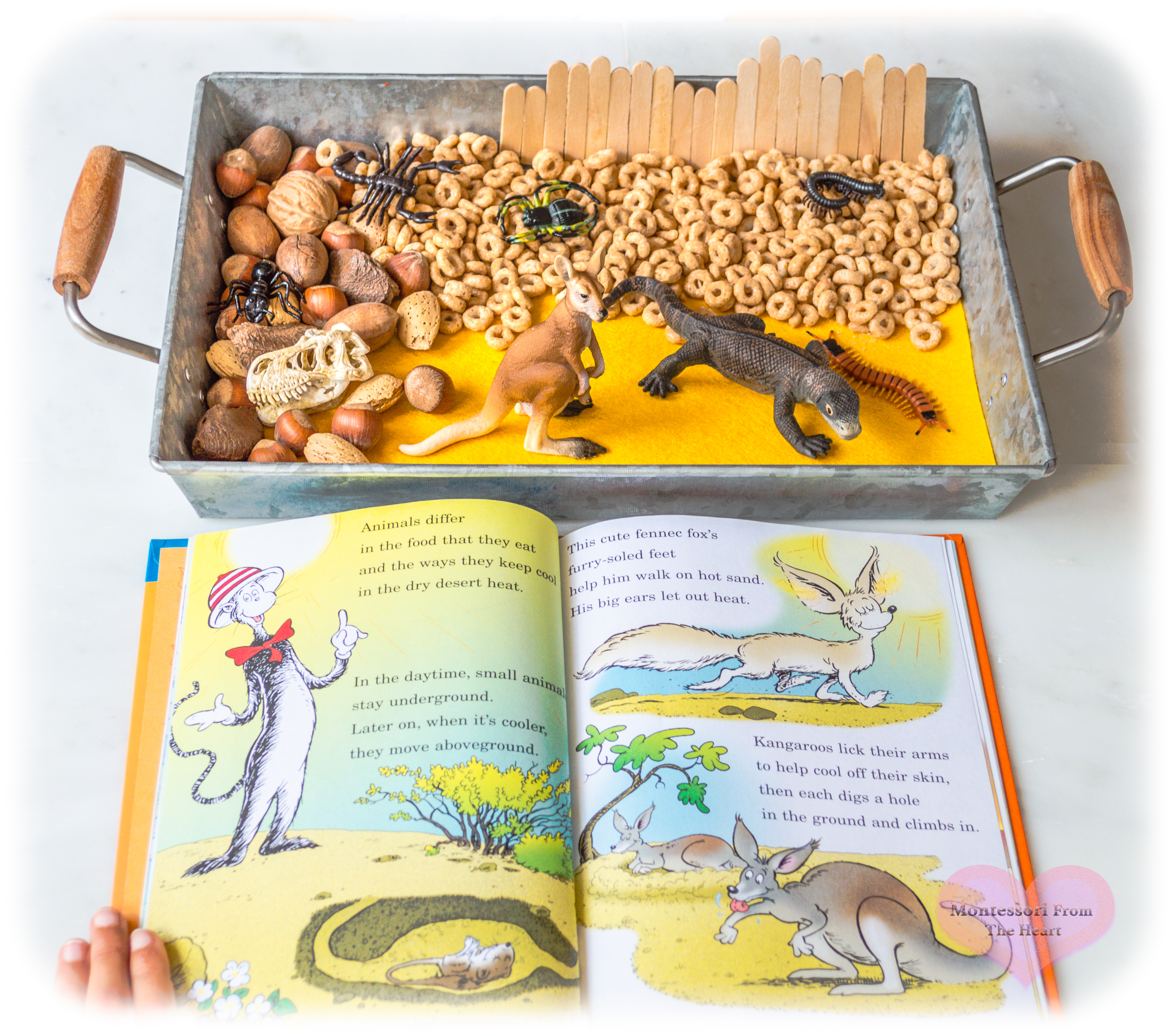
We explored the fascinating desert environment with one of our favorite books from The Cat in the Hat’s Learning Library: Why Oh Why Are Deserts Dry?: All About Deserts. To bring the book to life, I created a sensory bin inspired by the desert, using yellow felt for the sand, cereal, and nuts as textured fillers and craft sticks hot-glued together to resemble sand dunes.
As we played, we discussed the animals that call the desert home, their unique habits, and their diets. The activity also introduced new vocabulary like “mirage,” “dunes,” and “oasis,” sparking curiosity and language development. For added fun, we included desert-dwelling bugs, but our main focus was on the Komodo dragon and the kangaroo. This hands-on, imaginative activity made learning about the desert an engaging and memorable experience!
Komodo Dragons: Relics of Prehistory

Komodo dragons are incredible examples of reptilian “megafauna” and true relics of prehistory. As the largest living species of lizard, Komodo dragons can grow up to an impressive 3 meters (10 feet) in length and weigh as much as 70 kilograms (150 pounds). These fascinating creatures are now found only on a few islands in Indonesia, including the island of Komodo, from which they take their name.

More About the Komodo Dragon
The Komodo dragon thrives in hot, dry environments, preferring low-elevation habitats like open grasslands, savannas, and tropical forests. It is primarily active during the day and is a solitary creature, coming together only to eat or breed. Despite its massive size, the Komodo dragon is an impressive athlete—it can sprint briefly at speeds up to 20 km/h (12 mph), dive as deep as 4.5 meters (15 feet), and, when young, climb trees using its sharp claws.
To catch prey that’s out of reach, the Komodo dragon may balance on its hind legs, using its powerful tail for support. As it grows older, climbing becomes impractical due to its size, and its claws are mainly used as weapons. For shelter, these lizards dig burrows up to 3 meters (nearly 10 feet) wide using their strong forelimbs and claws. These burrows help them conserve body heat at night, minimizing the time they need to bask in the morning.

Feeding and Hunting Behavior
Komodo dragons are carnivores with a slow metabolism, allowing large individuals to survive on as few as 12 meals per year. They are known to ambush live prey, charging at high speeds and targeting the underside or throat to deliver fatal injuries. Contrary to popular belief, Komodo dragons don’t rely on septic bacteria in their saliva to bring down prey. Research from 2013 showed their mouths host bacteria similar to other carnivores. Instead, their sharp teeth and powerful bite cause severe trauma and rapid blood loss, often killing prey within seconds.
Komodo dragons have been observed regurgitating indigestible materials, such as hair, horns, and teeth, in a malodorous “gastric pellet.” Afterward, they rub their faces in dirt or bushes to remove the unpleasant mucus, suggesting even they don’t enjoy the smell.

Myths Debunked
Popular myths about Komodo dragons, like the idea that they let prey escape to die from sepsis or track rotting flesh on their teeth, have been debunked. Studies show they actively kill their prey and don’t wait for it to succumb to infection. In cases where water buffalo appeared to die from sepsis after an attack, it was likely due to their instinct to flee into contaminated water, which led to infections.
With their incredible physical abilities, fascinating behaviors, and survival adaptations, Komodo dragons remain one of nature’s most awe-inspiring creatures.
Australia Arid Desert Komodo Dragon and Kangaroo Sensory Bin

But why feature a Komodo dragon alongside a kangaroo, a well-known Australian native? Interestingly, scientists have discovered that the Komodo dragon likely originated in Australia. Research suggests that these lizards dispersed westward to Indonesia rather than evolving their size due to isolation on the islands. Over the past three years, an international team of scientists has unearthed fossils in eastern Australia dating back between 300,000 and 4 million years, confirming that these prehistoric giants once roamed the Australian landscape.
Kangaroos: The Iconic Australian Marsupials
Kangaroos, on the other hand, are synonymous with Australia. Belonging to the Macropus family—which translates to “big foot”—kangaroos are known for their powerful hind legs, long muscular tails, and small front limbs. The name “kangaroo” has an intriguing origin. According to legend, it comes from the Aboriginal word meaning “I don’t understand,” which was reportedly the response given to British navigator James Cook when he asked what the animal was called.
One of the kangaroo’s most fascinating features is its unique locomotion. Their hind legs function like a rubber band, propelling them forward with each powerful jump. Remarkably, the faster a kangaroo moves, the less energy it uses, making their signature hopping motion both efficient and effective.
Bringing It All Together
While the Komodo dragon and kangaroo seem worlds apart, their shared connection to Australia offers a fascinating glimpse into the continent’s prehistoric and present-day wildlife. From the megafauna of ancient times to the iconic marsupials bounding through modern Australia, these creatures are a testament to the unique and evolving biodiversity of the region.
For More Australian Animals Sensory Bins Activities for Kids,
See here How to Make a Recycled TPR Australian Animals Hotel DIY Craft.

For details on how to make Snack Tray Hack Australia Biomes, click here.

Want more?
If you liked these Montessori SafariLTD Australian Animals Small World invitations, see HERE Bee Lifecycle Sensory Bin. Also, see HERE Insects Black Bean Sensory Play.
Did you enjoy Australia Animals Sensory Bins Activities for Preschoolers? Which one was your favorite? Let me know in the comments below.
Learning About Emotions with Kids Free Printable ~ click here.

What are the 9 Play Schemas | Free Guide ~ here.

RECENT BLOG POSTS

Mackenzie-Childs Easter Decor Ideas | Charming Spring Home Inspiration
Mackenzie-Childs Easter decor ideas bring cheerful spring charm to your home and inspire a warm, welcoming Easter space for family gatherings.

Spring Montessori Activities for Preschoolers | Simple Hands-On Learning at Home
Spring Montessori Activities for Preschoolers bring calm, hands-on learning into your home, so your child explores nature, builds skills, and grows in confidence.

Easter Activities Round Up for Preschoolers at Home | Simple Hands-On Learning
Easter Activities Round Up for Preschoolers at Home bring simple hands-on learning that builds fine motor skills, early math, and calm focused play for little learners.
Disclosure: As an affiliate, I may earn a commission or credit should you choose to purchase something, but there is no additional cost to you. I only share products and programs that I use and love!