Discover how playdough supports sensory exploration, fine-motor skills, creativity, and independent play—and why sometimes simple playdough is best.
Playdough has been a favorite in our home since Adrian was about 10 months old. At first, we kept it very simple. I would make homemade playdough with flour and water, and he would squish, tear, pinch, pull, and poke it with his little fingers. It was messy, simple, and wonderfully hands-on.
As he got older, he began watching his big sister use playdough tools. She loved using sets such as a Play-Doh Doctor Drill ’N Fill and an ice cream playset, and naturally, Adrian wanted to do exactly what she was doing. Children learn so much by watching and imitating older children, and playdough gave him an easy way to join in.
But one day, his sister wasn’t around, and something interesting happened.
Instead of reaching for the tools, Adrian went back to the basics.
I showed him how to roll a snake and how to make a ball. From there, he took over. What he created was much more elaborate than anything I had seen him make when he was using the playdough tools.
And it made me stop and think: Are playdough tools helping children create—or are they sometimes telling children what to create?

Why Simple Playdough Can Be So Valuable:
There is certainly nothing wrong with playdough tools. Rolling pins, cutters, molds, scoops, and other accessories can add variety and give children opportunities to practice using different movements.
But tools aren’t necessary for meaningful playdough exploration.
Sometimes, putting out nothing more than a lump of playdough gives a child the greatest amount of freedom.
Without a tool telling him to make an ice cream cone, cut a shape, or fill a mold, Adrian had to decide what he wanted to make. He rolled, pinched, stretched, joined pieces together, and experimented with different shapes.
That open-ended process is important because there isn’t one “right” answer.
The playdough can become a robot, a cake, a snake, a flower, a person, or something that only makes sense to the child who created it. The value is not necessarily in the finished object. It is in the thinking, experimenting, and creating that happens along the way.
This fits beautifully with a Montessori-inspired approach: give the child enough guidance to get started, then leave room for the child to take ownership of the work.
The Association Montessori Internationale describes the adult’s presentation as showing the minimum necessary for a child’s active engagement, with the goal of allowing children to move toward self-directed learning and discovery.
And Then There Was a Robot…
This was Adrian’s robot.
He even used gel pens to draw the face. 🙂
What I loved most wasn’t how the robot looked.
It was watching the process.
He had started with a ball of playdough. Then another piece. Then another. He decided where everything belonged and kept changing the creation as he went.
That is the part I want to remember.
Sometimes, when we give children more tools, more choices, and more instructions, we think we are giving them more opportunities.
But sometimes less really is more.
When the tools disappeared, Adrian didn’t stop creating.
He created more.
And that made me wonder if the most helpful thing we can give our children isn’t always another tool—but sometimes simply the space to discover what they can do with what they already have.

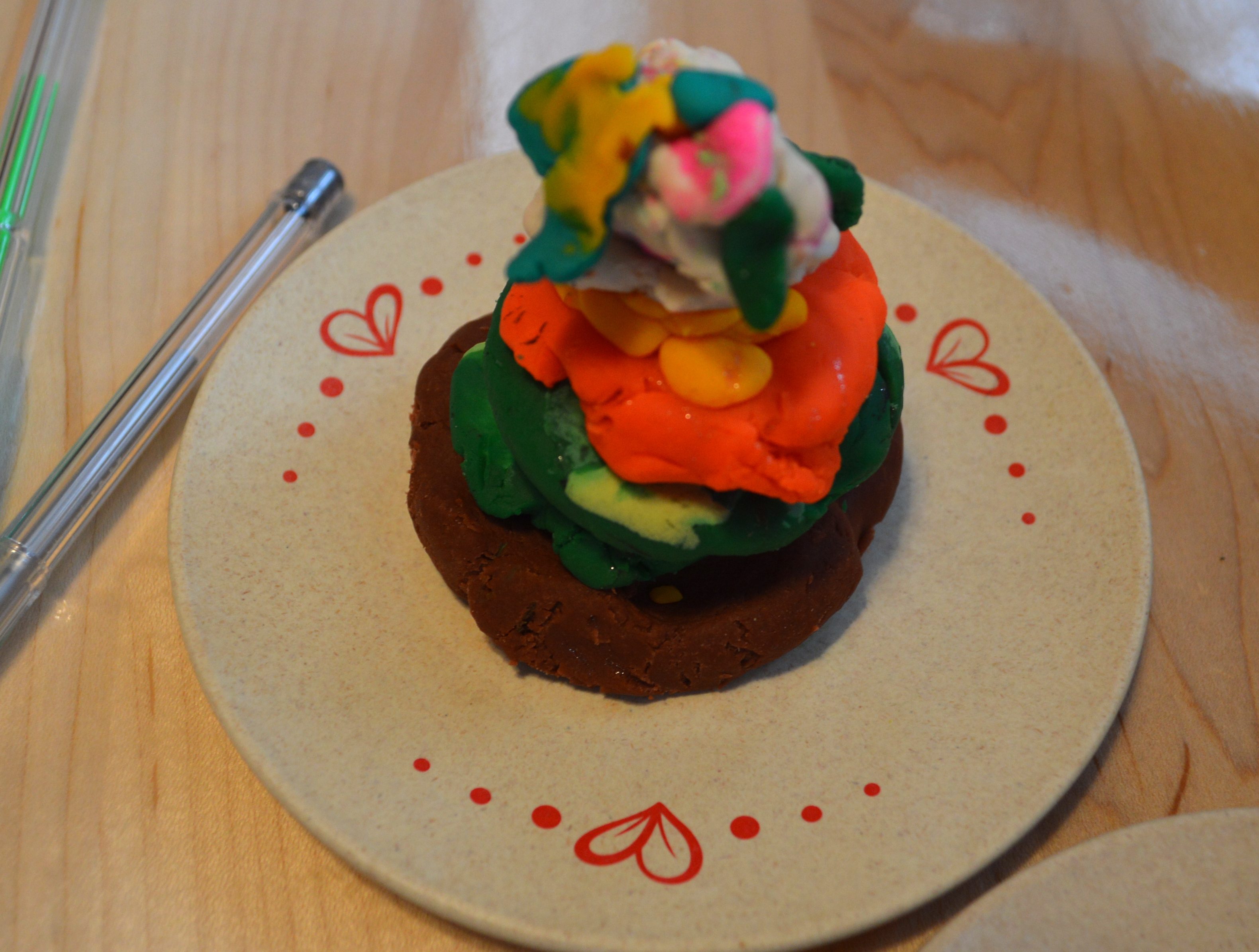
 Above is a “lollypop” (I guess he meant a cake?)
 How thin did he roll the orange snakes!
Developmental Benefits of Playdough:
Playdough looks like simple play, but those little hands are doing quite a lot.
Fine-Motor Skills: Squishing, pinching, rolling, pulling, twisting, and poking playdough all require the child to use the small muscles of the hands and fingers. These movements give children opportunities to practice hand strength, coordination, and controlled movement. Later, these same general skills support many everyday tasks, from manipulating small objects to using pencils, scissors, and utensils. Montessori education places a strong emphasis on purposeful hand movement. Hands-on experiences allow children to explore through touch while coordinating movement with thought.
Hand-Eye Coordination: When a child tries to roll a snake to a particular length, connect two pieces, or balance one piece of playdough on another, the eyes and hands have to work together. The child makes a plan, watches what happens, and adjusts the movement. That process may look effortless to us, but it is valuable practice for developing motor control.
Sensory Exploration: Playdough is a wonderful tactile material. It is soft, squishy, stretchy, sticky, and moldable. A child can squeeze it firmly or touch it gently. They can flatten it with the palm of the hand or use one finger to make tiny marks. For young children, this kind of direct sensory exploration gives them information about how materials feel and how they respond to their actions. Montessori sensorial education similarly emphasizes learning through concrete, hands-on experiences rather than simply being told about a quality or concept.
Creativity and Imagination: This is the part that fascinated me most about Adrian’s play. When I gave him a simple ball of playdough, I didn’t know what he was going to make—and neither did he. He had to come up with the idea himself. That is very different from handing him a mold that produces a particular shape. A mold can be fun and useful, but open-ended materials leave more decisions to the child. The Association Montessori Internationale describes creative expression as something that can emerge when children have opportunities to perceive, explore, manipulate, and express their own ideas rather than simply reproduce a prescribed product.
Problem-Solving: What happens when the head falls off the body? What can you do if the snake breaks? How can you make a tower stand up? Children encounter these little problems constantly while working with playdough. They experiment, make adjustments, and try again. These are simple forms of problem-solving, but they are meaningful opportunities for children to practice flexible thinking. Creative play also gives children opportunities to practice skills such as attention, working memory, planning, and cognitive flexibility. Harvard’s Center on the Developing Child identifies creative play as one context in which children can practice these developing executive-function skills.
 |  |  |
Tools or No Tools? My Answer: Both.
After watching Adrian, I don’t think the answer is tools versus no tools.
I think the better question is:
What does my child need right now?
Sometimes a child may benefit from a rolling pin, cookie cutter, or other tool. It introduces a new way of manipulating the dough and can provide an appropriate challenge.
Other times, removing the tools can open up a completely different kind of exploration.
So rather than putting every possible accessory on the table, try alternating between the two.
Try a “bare bones” playdough invitation
Put a small amount of playdough on the table and let your child explore it without any accessories.
You might demonstrate just two or three basic movements:
- “Let’s make a ball.”
- “Watch me roll it.”
- “Look, I made a long snake.”
Then pause.
You don’t need to show your child what to make next.
Give them time to experiment.
Add tools later
On another day, offer one or two tools rather than an entire playdough kit.
For example, try:
- A small rolling pin
- A blunt playdough cutter
- A wooden craft stick
- A cookie cutter
- A child-safe plastic knife
- A small cup or container for making impressions
Observe what your child does with them.
If your child immediately starts creating, wonderful. If the tools become the focus rather than the playdough itself, you can always simplify the invitation next time.
Let Your Child’s Ideas Lead:
One of the easiest ways to accidentally take over a child’s creative process is to start making suggestions too quickly.
You may see a lump of playdough and think, “Let’s make a snowman!”
But your child may have been making a dinosaur.
Or a birthday cake.
Or something you will never figure out.
Instead of asking, “What are you making?” over and over, try describing what you see:
“You made a very long orange snake.”
“I see you put the small ball on top.”
“You are using your fingers to make lots of little marks.”
This keeps you connected to your child’s work without deciding what the work should become.
And if your child tells you, “It’s a robot,” you can follow their lead.
“Your robot has two arms.”
“Where will the robot go?”
This kind of conversation can naturally expand vocabulary, storytelling, and pretend play without turning the activity into a lesson.

Playdough and Montessori at Home:
Playdough isn’t a traditional Montessori material in the same way as the Pink Tower or Knobbed Cylinders. But that doesn’t mean it can’t have a place in a Montessori-inspired home.
What matters is how the activity is offered.
A Montessori-inspired playdough invitation can be:
- Simple rather than overloaded
- Accessible to the child
- Hands-on and sensory
- Open-ended
- Appropriate for the child’s current abilities
- Introduced with a short demonstration
- Followed by time for independent exploration
- Easy for the child to help clean up afterward
This reflects several broader Montessori principles, including hands-on learning, child-directed activity, concentration, independence, and observation.
The American Montessori Society describes Montessori environments as places where children choose meaningful work at an appropriate level of challenge and work with materials through active, hands-on exploration.
Most importantly, you don’t need to turn every playdough session into a Montessori lesson.
Sometimes a child simply needs time to create.
Working Together: What’s for Dessert?
One of my favorite things about playdough is that there doesn’t have to be a finished product.
One child may make a robot.
Another may make a cake.
Another may roll the dough into dozens of tiny snakes and never make anything recognizable at all.
All three can be worthwhile.
So the next time you set out playdough, consider starting with just the dough.
Watch.
Wait.
Let your child decide what happens next.
And if they want to add the tools later, that’s wonderful, too.
The goal isn’t to choose between tools and creativity. It’s to make sure the tools serve the child’s exploration—not replace it.
Summary:
Playdough is a simple, hands-on activity that gives young children opportunities to explore, create, and develop important fine-motor skills. From squishing and pinching to rolling, stretching, and shaping, children strengthen their hands while learning how different movements affect the material. Playdough also encourages sensory exploration, problem-solving, imagination, and open-ended creativity.
While playdough tools can add variety and introduce new skills, they aren’t always necessary. Sometimes, giving a child nothing more than a piece of playdough allows more freedom for independent thinking and self-expression. As Adrian discovered, when the tools were removed, his creativity didn’t disappear—instead, he created something entirely from his own imagination.
The goal isn’t to choose between tools and no tools, but to observe your child and provide what supports their exploration at that moment. Whether they’re making a robot, a cake, a snake, or something only they can explain, the process of creating is where much of the learning happens.
For My No-Cook Playdough Recipe,
Want More Hands-On Ideas Like This?
Sign up for the Monthly Kids Activities Plan (MKAP) and receive themed activities, printables, and video tutorials each month—so you can spend less time searching and more time playing!
Click here to learn more about MKAP.

Disclosure: As an affiliate, I may earn a commission or credit should you choose to purchase something, but there is no additional cost to you. I only share products and programs that I use and love!
RECENT BLOG POSTS

DIY Spider Web Watercolor Resist Art | Halloween Process Art for Kids
Create a colorful spider web watercolor resist with kids! This Halloween process art activity builds creativity, fine motor skills, and sensory exploration. Looking for a Halloween art activity that feels a little different from the usual crafts? This spider web watercolor resist art combines drawing, hot glue, and watercolor paint to create a raised 3D…

Halloween Sensory Bin for Toddlers | Spooky Fine Motor Play
Halloween Sensory Bin for Toddlers | Spooky Fine Motor Play gives little hands a fun way to scoop, sort, explore, and build fine motor skills.

Halloween Sensory Bin for Preschoolers | Spooky Play
Halloween Sensory Bin for Preschoolers | Spooky Play creates hands-on Halloween fun while building fine motor skills, focus, and sensory awareness.