
Make a DIY Thankful Tree with your kids! This easy Thanksgiving gratitude craft encourages preschoolers to reflect on family, friendship, and life’s little joys.
As Thanksgiving approaches, I like to slow down and reflect on the many blessings in our lives. Amid the excitement of the holidays, this is a wonderful opportunity to help children notice the people, experiences, and little things that bring them joy.
Gratitude is more than simply saying “thank you.” It means recognizing what we appreciate and understanding why it matters to us. By modeling gratitude in everyday life, we can help children develop an attitude of appreciation rather than focusing on what they do not have.
Of course, young children are still learning to understand their feelings and express them in words. That is why I love introducing gratitude through simple, hands-on activities.
Today, I invited Adrian to pause and think about the people and things that make him happy. Who does he love? What makes him smile? What little things does he appreciate?
To display his reflections, we created a DIY Thankful Tree using recycled materials, pipe cleaners, and beautiful autumn decorations. Each handmade heart represents something Adrian feels thankful for. Together, they create a meaningful Thanksgiving decoration and a gentle reminder to appreciate the abundance already around us.
“Each day, each season, each cycle offers something of beauty. Let us notice and give thanks.” – Diane Mariechild.

What Is a Thankful Tree?
A Thankful Tree is a simple gratitude activity in which children identify people, experiences, and things they appreciate. They write, draw, or dictate their thoughts on paper leaves, hearts, or other seasonal decorations. These pieces are then added to a handmade tree.
As the tree fills with thankful messages, children can see their gratitude grow.
This activity offers a tangible way to introduce an abstract concept. Rather than simply telling children to be grateful, we invite them to think about what gratitude means in their own lives.
A Thankful Tree also makes a lovely Thanksgiving centerpiece. You can create one as a family, add new messages throughout November, or make it an annual tradition.
 Cut the bottom of the paper-towel roll in strips, so that the tree will stand.
What You Will Need to Make a DIY Thankful Tree:
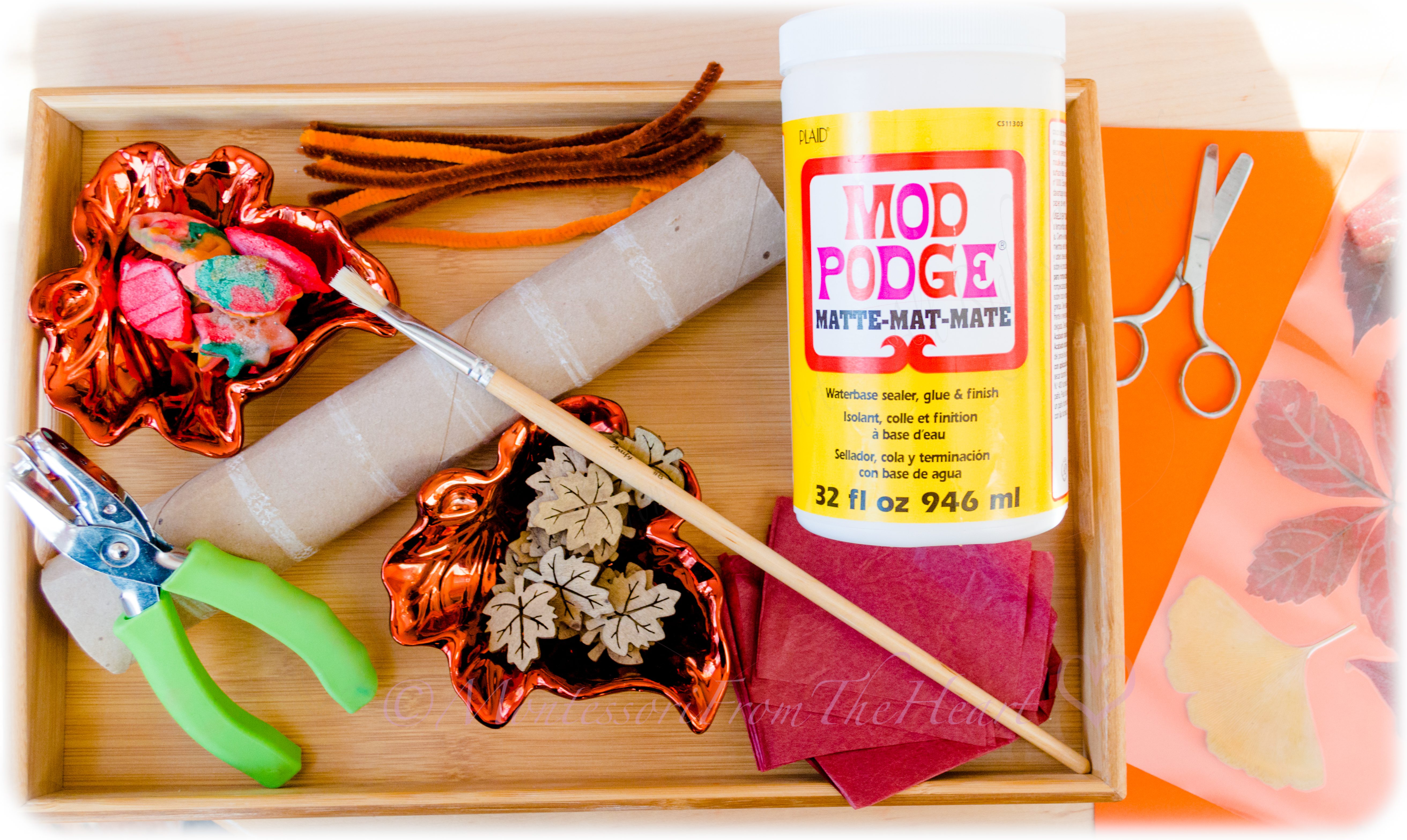
One of my favorite things about this Thanksgiving craft is that you can use materials you already have at home. We incorporated recycled items, natural treasures from our nature walks, and decorations Adrian had made previously.
Here is what we used:
- An empty paper towel roll or cardboard tube for the tree trunk
- Mod Podge or another suitable paper-mache adhesive
- Brown tissue paper to cover the trunk
- Pipe cleaners to create the branches
- A hole punch
- Paper hearts for writing or drawing thankful messages
- Wooden maple leaves
- Laminated dried leaves collected during nature walks
- DIY play dough leaves
- Optional felt leaves, acorns, and pinecones for decorating
You can substitute construction paper, cardstock, or other lightweight decorations. There is no need to purchase everything. Let your child help choose materials and personalize the tree.
 Using paper mache technique, cover paper-roll with brown tissue paper to resemble the trunk.
How to Make a Thankful Tree With Kids:
Step 1: Prepare the tree trunk
Start with an empty paper towel roll. Cut several vertical slits around the bottom of the cardboard tube. Fold the strips outward to create a stable base so the tree can stand upright.
An adult should handle the cutting if your child is not yet ready to use scissors safely.
Step 2: Cover the trunk with brown tissue paper
Using a paper-mache technique, cover the cardboard roll with brown tissue paper and your chosen adhesive. We used Mod Podge to attach the tissue paper.
Allow the trunk to dry completely before moving on to the next step.
The brown tissue paper gives the cardboard a natural, tree-like appearance.
Step 3: Add the branches
Once the trunk has dried, make several small holes along the upper portion of the tube. Insert pipe cleaners through the holes to create branches.
I double-twisted our pipe cleaners to make them sturdier and easier to shape. Bend each branch outward so it resembles the natural structure of a tree.
An adult should make the holes and secure the pipe cleaners. Fold or cover any sharp wire ends.
 Once the ♻️roll is dry, make holes and insert double-twisted pipe-cleaners as branches.
Step 4: Prepare the Thankful Decorations
Now comes the meaningful part!
Prepare paper hearts for your child’s gratitude reflections. You can cut the hearts from construction paper or cardstock. Keep them large enough for little hands to decorate and for older children to write a few words.
Before adding the hearts, invite your child to think about what makes them happy.
You might ask:
What is something you appreciate about yourself?
Younger children can answer verbally while an adult writes their words on the hearts. Older preschoolers may enjoy drawing pictures or attempting to write their own messages.
 I laminated dried leaves to use as decorations in addition to Adrian’s Thankful Hearts.
Step 5: Decorate your Thankful Tree
Once your hearts are ready, attach them to the pipe-cleaner branches. We used paper clips instead of traditional ornament hooks because they are easy to attach and remove.
We also decorated our tree with wooden maple leaves and laminated dried leaves collected during nature walks.
I love incorporating natural materials into our seasonal crafts. Collecting leaves outdoors adds another layer to the activity and gives children an opportunity to observe the changing seasons.
We also used DIY play dough leaves Adrian had made earlier. You can find our Fall-Inspired Natural Play Dough Activity for inspiration.

“Gratitude means thankfulness, counting your blessings, noticing simple pleasures, and acknowledging everything that you receive. It means learning to live your life as if everything were a miracle, and being aware on a continuous basis of how much you’ve been given.” ~ Marelisa Fábrega.

Paper-clips work great instead of ornament hooks. See here “🍁Fall-Inspired Odd & Even” activity using these wooden maple leaves.
You can also add felt leaves, acorns, and pinecones to create a beautiful autumn display. The ends of the pipe cleaners can help secure lightweight decorations.
 Adrian is thankful for Julia, Mam, and Dad. His world is small yet but plentiful.
 Adrian decorated his Thankful Tree with DIY play dough leaves (see how he made them here).
 The ends of pipe-cleaners can also be used to attach decorations to.
 Adrian is also thankful to himself for himself.

We also added felt leaves, acorns, and pine-cones as decorations.
Step 6: Display Your Family’s Gratitude
Find a special place to display your finished Thankful Tree. You can add new hearts whenever someone thinks of something they appreciate.
I invited Adrian to share his reflections, and his answers reminded me that a child’s world can be small yet so plentiful.
He was thankful for Julia, Mam, and Dad. He was also thankful for himself!
I especially loved that last answer. Gratitude does not have to focus only on the people around us. Children can also learn to appreciate their own qualities, efforts, and accomplishments.
Our tree became more than a Thanksgiving decoration. It became a visual collection of the little things that make our family happy.

“In the past I always thought of gratitude as a spontaneous response to the awareness of gifts received, but now I realize that gratitude can also be lived as a discipline. The discipline of gratitude is the explicit effort to acknowledge that all I am and all I have is given to me as a gift of love, a gift to be celebrated with joy.” ~ Henri Nouwen.
Why Make a Thankful Tree? Developmental Benefits for Children:
A DIY Thankful Tree is more than a seasonal craft. It creates an opportunity for children to practice reflection, express their feelings, and connect with the people they love.
Here are a few meaningful ways this activity supports early childhood development.
1. Encourages emotional awareness
When children think about what makes them happy, they begin to identify and communicate their feelings. Questions such as “What makes you smile?” or “Who makes you feel loved?” encourage children to connect experiences with emotions. Young children may need help finding the words. Give them time to think, listen without correcting their answers, and accept simple responses.
2. Introduces gratitude through everyday experiences
For preschoolers, gratitude is easier to understand when it connects to familiar people and experiences. A child might feel thankful for a favorite bedtime story, a sibling who plays with them, a warm meal, or a walk outside. Harvard’s Making Caring Common initiative emphasizes that gratitude involves noticing what we appreciate, thinking about why we appreciate it, and experiencing the positive feelings associated with that reflection. A Thankful Tree gives children a playful way to practice those steps.
3. Strengthens language and communication skills
Talking about gratitude encourages children to describe people, experiences, and emotions.
As you work together, introduce open-ended questions and give your child opportunities to explain their choices. You can also model more detailed language by expanding on their answers.
For example, if your child says, “I am thankful for Grandma,” you might respond, “You love spending time with Grandma because she reads stories with you.” Children can also practice new vocabulary related to autumn, nature, family, and emotions.
4. Develops fine motor skills
Cutting paper hearts, drawing pictures, holding crayons, attaching decorations, and placing leaves on branches all involve small hand movements. These activities give children opportunities to practice hand-eye coordination and fine motor control. Younger children can decorate pre-cut shapes with crayons or stickers. Older preschoolers can help cut paper, draw pictures, or write simple words with adult guidance.
5. Encourages creativity and independence
Montessori-inspired learning gives children opportunities to participate actively rather than simply watch an adult complete a project. Let your child choose the colors, select natural decorations, arrange the branches, and decide how to personalize the tree. There is no single correct way to decorate it. The finished project does not need to look perfect. The process of making choices and contributing ideas is what matters.
How to Adapt the Thankful Tree for Different Ages
You can introduce this gratitude activity to children at different developmental stages. Simply adjust the questions and the amount of adult assistance.
Toddlers (18 months to 2 years):
Keep the activity simple and concrete. Talk about familiar people, favorite toys, pets, and everyday experiences. Offer pre-cut, large paper shapes for your toddler to decorate with chunky crayons or stickers. You can write their answers for them. Short conversations are perfectly fine.
Young preschoolers (2 to 3 years):
Invite your child to name one or two people or things they appreciate. Ask simple questions and offer examples if they need help getting started. Children can draw pictures, decorate paper hearts, and help select lightweight decorations.
Older preschoolers (4 to 6 years):
Encourage children to explain why they appreciate someone or something. They can draw more detailed pictures, dictate complete thoughts, or write familiar words independently.
You can also invite them to think about acts of kindness they have experienced and ways they can show appreciation to others. Remember that every child develops at their own pace. There is no need to rush the process or expect a particular number of thankful messages.
Tips for Making Gratitude Meaningful:
The goal of a Thankful Tree is not to create a long list of things children should appreciate. We want to encourage genuine reflection. A few simple practices can make the experience more meaningful:
- Model gratitude yourself. Share something you appreciate and explain why it matters to you.
- Focus on little things. A favorite book, a sunny day, or time spent together can be just as meaningful as a special occasion.
- Give children time. Some children need a little longer to think about their answers.
- Avoid correcting their choices. Let children decide what feels important to them.
- Make it voluntary. Never pressure a child to express gratitude or share something they are not ready to discuss.
- Continue beyond Thanksgiving. Add a heart whenever someone has a meaningful thought to share.
The most valuable lesson is that gratitude can become part of everyday family life, rather than something we practice only during the holidays.
Frequently Asked Questions About Thankful Trees:
What is a Thankful Tree for kids?
A Thankful Tree is a hands-on gratitude activity in which children write, draw, or dictate things they appreciate on paper hearts or leaves. They attach these messages to a handmade tree, creating a visual reminder of the people and experiences that bring them joy.
What age can children make a gratitude tree?
Children can participate from around 18 months with close adult assistance. Toddlers can decorate pre-cut shapes, while preschoolers can share their thoughts, draw pictures, and write simple messages as their skills develop.
How do you teach preschoolers about gratitude?
Start with familiar experiences. Ask children about the people they love, activities they enjoy, and things that make them happy. Model appreciation in everyday situations and encourage children to explain why something matters to them.
What can children write on a Thankful Tree?
Children can include family members, friends, pets, favorite activities, nature, favorite foods, special memories, and things they appreciate about themselves. Younger children can draw pictures or dictate their answers to an adult.
How long can you keep a Thankful Tree?
You can display your tree throughout November or keep it as a year-round family gratitude activity. Add new messages whenever someone wants to share something they appreciate.
Final Thoughts: Growing a Little More Gratitude Each Day:
I love how this simple Thanksgiving craft gave Adrian an opportunity to pause and reflect on the people and experiences that make his life special. His little hearts reminded me that gratitude does not have to come from grand gestures or extraordinary events. Sometimes, the greatest blessings are the simplest ones: family, friendship, a kind gesture, a favorite activity, or simply having one another. As parents, we can help children notice these moments by making space for meaningful conversations and modeling appreciation in our everyday lives. May your Thankful Tree become a beautiful reminder to slow down, appreciate the little things, and celebrate the abundance already around us.
Happy Thanksgiving! Wishing your family a holiday filled with love, gratitude, and joy.
More Thanksgiving and Montessori-Inspired Activities:
- DIY Pipe Cleaner and Paper Mache Thanksgiving Turkey
- Thanksgiving-Inspired Homeschooling 101 Unit Study
- Montessori Peace Shelf: Grace, Courtesy, Gratitude, and Peaceful Character
- Fall-Inspired Natural Play Dough Activity
- Fall-Inspired Odd and Even Numbers Activity
Want More Hands-On Ideas Like This?
Sign up for the Monthly Kids Activities Plan (MKAP) and receive themed activities, printables, and video tutorials each month—so you can spend less time searching and more time playing!
Click here to learn more about MKAP.

Disclosure: As an affiliate, I may earn a commission or credit should you choose to purchase something, but there is no additional cost to you. I only share products and programs that I use and love!
RECENT BLOG POSTS

How to Teach Kids Gratitude | 10 Thanksgiving Ideas
Ten ways to teach kids gratitude at Thanksgiving, from thank-you notes to everyday moments, written for mothers of children ages 1 to 6.

Name Recognition Finger Painting | Preschool Activity
Try name recognition finger painting for preschoolers! This fun Montessori-inspired activity builds fine motor skills, letter awareness, and early writing skills.

Loose Items Name Recognition Activities for Preschoolers | 2 Easy Hands-On Ideas
Try these two easy name recognition activities for preschoolers using nature finds and dot stickers. Build letter awareness, fine motor skills, and early literacy.